

Last month on the 16th, I attended TrustedTechTalks‘ “Future of Development” event. Joining me were three amazing speakers, Lee Englestone – Dev Relations Leader at Avanade, Neil Graham – founder of The Tech Locker, and Jeff Watkins – CPO & CTO at xDesign.
Lee opened for us, giving a truly amazing and energetic presentation on learning how to utilise AI, and not the LLM type of AI like ChatGPT! He talked us through his experiences learning everything from “simple” (note, it’s not simple, it’s bloody mad!) image identification models to RNN models and beyond. Lee’s enthusiasm for what he was talking about was infectious and before the end, I was almost as giddy as he was!
Next, Neil Graham gave a talk on the future of engineering, opening with “Everyone is an Engineer” and leaning heavily on the power behind no-code solutions for ‘civilian development’ before transforming “ordinary engineers” into SuperHeros, the ones who take a complex challenge and develop the optimal solution, something a civilian developer can’t do without the support, guidance and training that would make them a true Software Engineer. Neil touched on several topics close to my heart, having recently spent several months defining and delivering a ‘Citizen Dev’ manifesto and structured teaching plan in order to digitize a lot of paper-based processes that still existed within the business. A truly fantastic talk.
Then I stepped in, and despite my nerves over my first public speaking engagement, I actually fell into a rhythm quite quickly!
I talked through a bit of history around what my team and I were doing at TfGM, the technologies we were using and how we grew to meet the challenges while still delivering on time.
That, of course, isn’t actually what the talk was truly about, it was about optimisation of solutions and services, especially with Serverless technologies being involved. Optimisation is key to not only improving user experience (load times/etc), but also in reducing costs. Working at TfGM, reducing costs and balancing the savings from optimisations vs the human costs to deliver those optimisations is a core requirement of the Engineering Practice that I led.
Finally Jeff Watkins stepped up. Jeff is truly an extraordinary man with extraordinary knowledge and experience. He gave a riveting talk on emerging cybersecurity threats, talking through the evolution of cyber security threats and how the ominous “bad actors” are changing their attack vectors from brute-force assaults on digital infrastructure to logical attacks on squishy meatbags, using AI to build deep-fakes of people in power to overcome natural human barriers and the hope that AI will be able to identify AI built attack surfaces in the near future.
Jeff’s talk left us all speachless. While we’re all pretty smart and understand the fundamentals, like don’t stick random USB sticks in your laptop, hearing there are new and far more disciplined solutions being built to actively assault the individuals rather than the infrastructure in order to gain access to data and systems, it’s got me thinking heavily about the way I handle several security measures I have in place too.
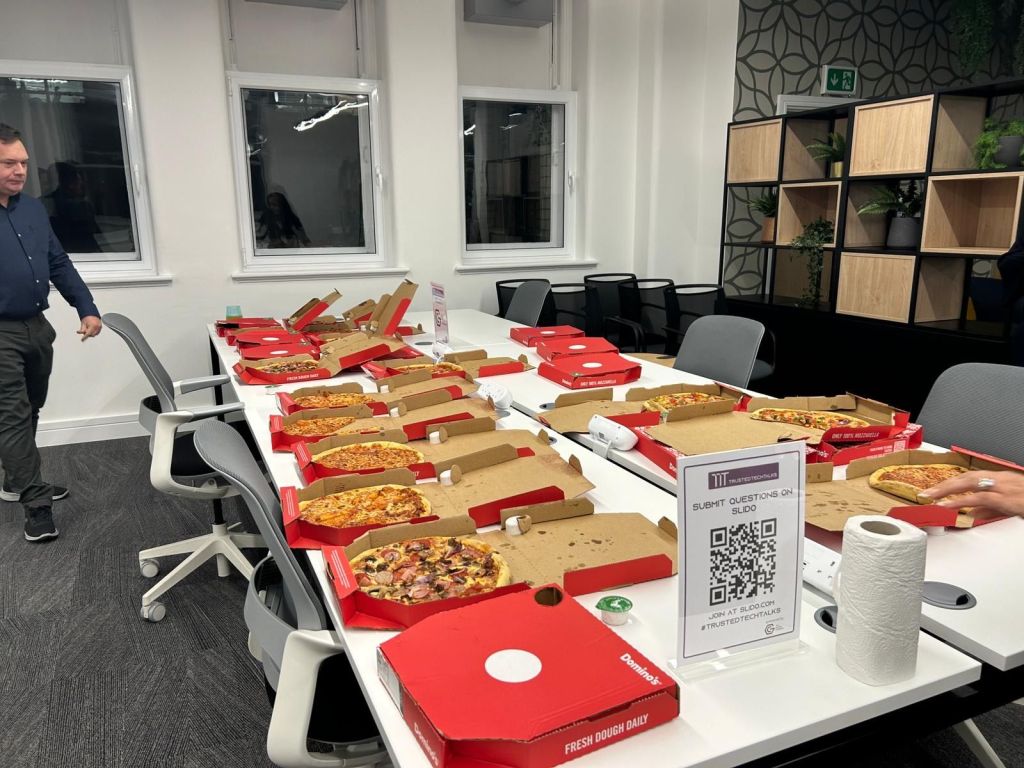
And of course, there was a lot of pizza involved. I’m not embarrassed to say I ate my bodyweight in pizza that night!
The whole night was recorded, so as soon as those recordings go live, I’ll be linking them here too.
I’m honestly psyched by the turn out and feedback that we received. It was a truly fantastic night and I can’t wait for the next one or to see you there!
D.
 Danielle Summers
Leave a comment